Majesty Airlines
bet-being-taste

| IATA | ICAO | Call sign |
|---|---|---|
HM |
MJT |
MAJESTY |
- Founded
- January 31, 1952 (74 years ago)
- Parent company
- #group:majesty
- Region
- #region:eur
- Headquarters
- London, England, #country:united-kingdom
- Alliance
- #alliance:orbis
- Frequent flyer program
- Royal Flyers Club
- Website
- hmmajesty.com
- Hubs
- Edinburgh
- London City
- London Gatwick
- London Heathrow
- Manchester
- Subsidiaries
- Majesty Cityflyer
- Slogan
- "His Majesty's airline"
- Tags
- #airline:majesty-airlines
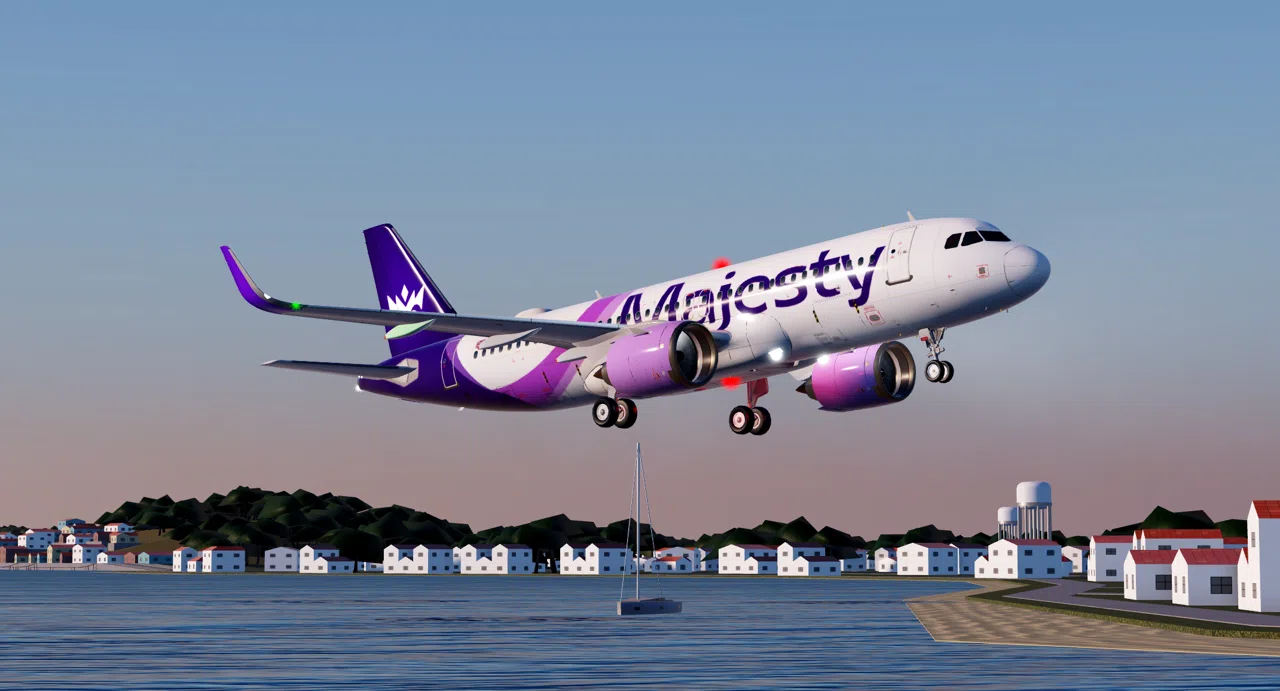
Majesty, trading name of Majesty Airlines is the British flag carrier airline headquartered in London, England. It operates domestic and international scheduled services on over 200 routes in more than 33 countries via its major hub from London Heathrow and others. The company employs around 14000 people, based throughout the world but mainly in the UK. The airline are controlled by a holding group, Majesty & Partners.
Since its establishment in 1952, Majesty has expanded through a combination of acquisitions, and base openings, driven by consumer demand for travel to Great Britain. The group, along with associate companies, operates 201 aircraft. It has 6 bases, with its largest at London Heathrow.
Majesty uses an Airbus, Boeing and Embraer fleet and operates destinations to 6 continents globally.
Contents
History
Origins
In 1952, Royal Majesty Airways was established, being the first company in what would later become the Majesty & Partners Group. Upon launch, it employed just 40 people; the company was based at London Croydon Airport. Using British made Vickers Viscounts, they flew passengers from London to major European cities such as Paris and Amsterdam.
During the late 1950s the airline gradually expanded its network across Western Europe, introducing services to Brussels, Copenhagen and Zurich. Demand for international air travel increased significantly during the decade, allowing Royal Majesty Airways to grow its fleet and workforce while establishing itself as a small but reliable British carrier.
By the late 1950s, the limitations of Croydon Airport and the rapid growth of commercial aviation in London led the airline to begin planning a move to London Heathrow Airport, which was undergoing redevelopment to handle larger passenger volumes and modern jet aircraft.
In the 1960s, Royal Majesty Airways steadily relocated its primary operations to London Heathrow Airport, as commercial aviation in London continued to expand and Croydon Airport became increasingly unsuitable for larger passenger aircraft. The move allowed the airline to operate from a modern facility with improved runway capacity and passenger infrastructure.
Throughout the decade, Royal Majesty Airways expanded its European network from Heathrow, adding new routes to cities including Rome, Madrid and Vienna. Passenger numbers steadily increased as air travel became more accessible across Western Europe.
During 1972, the airline began modernising its fleet with the introduction of Hawker Siddeley Trident aircraft, marking Royal Majesty Airways’ transition into the jet age. The new aircraft gradually replaced the airline’s ageing Vickers Viscount turboprops, offering higher passenger capacity, faster journey times, and improved operational efficiency.
The introduction of the Trident allowed Royal Majesty Airways to expand further into leisure markets, particularly Spain, southern France and Italy, where demand for holiday travel from the United Kingdom was rapidly growing.
Jet Age
The late 1970s marked a gradual shift in strategy for Royal Majesty Airways, as the airline began adopting elements of a business operating model in response to growing competition in global aviation. While traditional scheduled services remained part of the network, increasing emphasis was placed on business routes and high-demand leisure destinations from London Heathrow Airport. Including the delivery of the first 747-200s, priding as the first long haul aircraft of Royal Majesty.
Fleet growth continued with additional deliveries of the Hawker Tridents, which became the core aircraft type for the airline. The jet’s efficiency and capacity allowed Royal Majesty Airways to expand its network while maintaining competitive fares.
Royal Majesty Airways operated the Concorde, the world's first supersonic aircraft that first carried passengers on the 21 of January 1976 from London Heathrow to Bahrain. Services to the USA began on 24 May 1976 to Washington Dulles, and flights to New York JFK followed on 22 September 1977. Following the crash of Marianne Flight 4590 and the 11 September attacks, Royal Majesty Airways decided to cease Concorde operations in 2003 after 27 years of service. The final commercial Concorde flight was HM002 from New York-JFK to London-Heathrow on 24 October 2003.
By the late 1980s, the airline had built a fleet of approximately twenty aircraft based primarily at Heathrow. Services to European destinations such as Spain, Portugal and southern France formed a growing share of the route network, reflecting rising demand for affordable travel and connecting passengers from the United Kingdom and the world.
Expansion followed with the acquisition of AirBritons, a small regional carrier founded in 1988 with a fleet of four Boeing 737-200 aircraft. AirBritons operated regional flights connecting Gatwick with nearby European cities, including Zurich, Munich and Vienna. The purchase provided Royal Majesty Airways with a foothold in Gatwick airport and access to airport slots at Gatwick, which quickly became an important continental base.
Fleet growth during this decade allowed the airline to gradually replace older aircraft while integrating AirBritons’s operations into the wider network. European short-haul routes remained a focus, but the 1990s also marked the beginning of Royal Majesty Airways’ transformation into a pan-global carrier.
New Millennium
The 2000s marked a transformative period for the airline, combining fleet modernization with network expansion across the United Kingdom and Europe. In 2000, the first Airbus A320-200 was delivered, beginning a process that would ultimately replace all older Hawker Siddeley Trident and Boeing 737-200 aircraft. The introduction of the A320 allowed the airline to operate more efficiently, increase seating capacity, and reduce operational costs, which supported its emerging royal strategy.
In 2001, Majesty & Partners decided to take control of growing low-cost airline sevol, just two years after it's first flight. The growing demand for low-cost travel and their growing presence in London Stansted made sevol a perfect asset to the British Flag Carrier. However, one month later, the tragic 9/11 attack occurred, which slowed passenger travel and caused the company to lose an estimate of £295 million.
Network expansion accelerated during this decade. In 2003, the first 777-200ER aircraft was delivered into Heathrow airport and was set to replace the Tristar aircraft. Along with new 747-400s, Royal Majesty Airways had set up a large global reach and global image.
In 2004, the airline underwent a major rebranding, adopting the name “Majesty Airlines” to reflect its modern identity and focus on more professional operations. The rebrand was accompanied by a refreshed visual identity, including new livery designs and updated corporate branding, reinforcing the airline’s commitment to modernization and a consistent passenger experience across all markets.
Fleet renewal continued steadily throughout the decade. By 2009, all Boeing 737s & Tridents had been retired, leaving the A320-200 as the backbone of the airline’s fleet. This standardization simplified maintenance, reduced operational complexity, and allowed for more frequent rotations between bases. During this period, the airline also introduced new crew training programs, optimized turnaround times, and implemented early yield management systems to maintain competitive fares while maximizing revenue on high-demand leisure routes.
By the end of the 2000s, Majesty Airlines had firmly established itself as a modern luxury carrier with a growing global footprint, a standardized and efficient fleet, and a recognizable brand identity. The foundation laid in this decade would enable rapid expansion into Europe, the USA, and additional markets in the following years.
Just before 2009, Majesty Airlines finalised a deal to merge with Ibérica, Spain’s flag carrier. The merger was intended to expand Majesty & Partners presence in Europe while strengthening Ibérica’s international network through access to Majesty’s wider operations.
The 2010s represented a period of significant expansion and transformation for Majesty Airlines, reinforcing its position as a major carrier across Europe. In 2011, the airline inaugurated its first double decker Airbus A380 aircraft. It was the first of many to arrive for the United Kingdom. It was in this year, that Majesty begun over 20 new long haul routes for the London Olympics of 2012, which Majesty was the official partner of.
In 2012, Majesty & Partners undertook a major acquisition with the purchase of the SunTravel Group, which included the multinational leisure airline Sunw!ng UK & Ireland. Sunw!ng operated a diverse network across Europe with multiple bases in the United Kingdom, as well as a modern fleet of short- and long-haul aircraft. The acquisition allowed Majesty Airlines to integrate Sunw!ng’s established routes and resources, expand its presence in key European markets, and leverage a broader multinational operational footprint. This strategic move positioned Majesty as one of the fastest-growing low-cost carriers in Europe, capable of offering more destinations and increased frequency from multiple bases.
In 2016, CEO of 14 years "Mark Kasim" stepped-down, giving charge to "Jacque Freddie". Majesty Airline's reputation spiralled, being rated one of the worst for departure times in the United Kingdom, and lost most of its global image for luxuriousness. Jacque later stepped down in 2018.
After 2018 and later into the decade, Majesty Airlines focused not only on network growth but also on operational and customer-oriented improvements. Initiatives included streamlined scheduling, optimized aircraft rotations, enhanced in-flight services, and the development of advanced booking and loyalty programs. These efforts contributed to higher passenger satisfaction and better load factors across the network.
By 2019, the airline recorded its most successful year to date (before the 2020s), achieving record passenger numbers, robust financial results, and strong brand recognition across Europe. This period of growth established a solid foundation for the 2020s, enabling Majesty to expand into new markets, introduce longer-haul services, and continue its trajectory as a leading airline.
COVID-19 and Post-Covid
The onset of the COVID-19 pandemic in early 2020 led to an unprecedented decline in global air travel, and Majesty Airlines was no exception. Revenue dropped sharply as flights were temporarily suspended across the network. In response, the airline sold a portion of its fleet to preserve cash flow and maintain profitability during the unprecedented downturn.
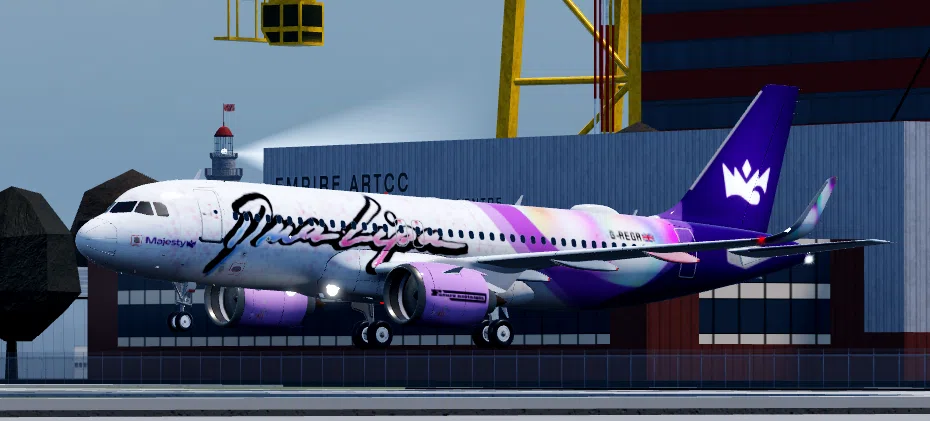
During lockdown, Majesty began developing innovative partnerships with external brands and artists to enhance its public profile and passenger experience. In a landmark collaboration, the airline worked with singer Dua Lipa, painting an Airbus A320neo (registration G-REGR) in a custom “Future Nostalgia” livery. This initiative highlighted Majesty’s commitment to modern branding and connecting with a younger audience. The special painting was removed in 2023. Operations gradually resumed in 2021, although financial results remained below those recorded in 2004, reflecting the ongoing challenges of the global aviation market.
It was also in 2021, when Majesty Airlines announced the unfortunate retirement of its entire 747-400 fleet. Originally intended to be phased out by 2025, the airline stated that the date was brought forward due to the low demand figures caused by the pandemic.
By 2022, passenger numbers and revenue began to rise again, as travel demand recovered across the world and key destinations. Majesty Airlines leveraged the momentum to further expand its marketing partnerships, combining entertainment, music, and travel into unique promotional campaigns.
Between 2023 and 2026, the airline launched additional artist partnerships to promote its fleet. From 2023, Olivia Rodrigo collaborated with Majesty on G-REGR, followed by a second partnership with Charli XCX in 2025. These collaborations rebranded the aircraft as the “Pop 'Craft”, a high-visibility marketing tool and flying tribute to contemporary pop culture, attracting media attention and boosting brand recognition while maintaining operational efficiency. G-REGR, is currently unaffiliated with any celebrity as of October 2026.
In mid-2026, Majesty Airlines was announced as a founding member of the future Orbis Alliance along with its partner, Ibérica.
Network
Majesty Airlines operates a varied network from 5 British airports.
London Heathrow
Heathrow, serving as London's largest airport, is the home of Majesty Airlines. Being the sole user of Terminal 5, Majesty has used the space to maximise their global operations since its opening in 2008.
Majesty offers a global network from Heathrow, with flights to departing to all 6 inhabited continents. Offering passengers from around the world easy connections on board one airline.
London Gatwick
London Gatwick, works as a substitute to London Heathrow. The network runs only to European destinations such as capital cities or tourist hot spots.
London City
Being solely operated by Majesty Cityflyer, Majesty Airlines uses their only Embraer fleet of aircraft from City Airport, serving for business customers in the heart of London's financial district.
Edinburgh
Majesty Airlines offers a range of long haul and European routes from the Scottish capital, using some of its most modern and efficient aircraft.
Royal Flyers Club
Read main article on Majesty & Partners
The Royal Flying Club, is a customer loyalty rewards program set up in 2011. Members earn points when flying onboard Majesty Airlines, HEKLA Iceland or Ibérica.
Partnerships
Orbis Alliance
Majesty Airlines is a founding member of the Orbis Alliance, which is set to start full operation during 2027. Orbis Alliance members include:
- China Pearl Airlines
- Columbia Airlines
- CNDA
- HEKLA Iceland
- Ibérica
- Joseon Air
- Nippon Airlines
- Pacific Airlines
External Partners
Majesty Airlines also has separate codeshares and interlines with non-orbis members, these being :
Corporate Affairs
| Year | Turnover (£bn) | Net Profit (£m) | Number of pax (m) | Number of employees | Load Factor (%) | Fleet Size |
|---|---|---|---|---|---|---|
| 2018 | 10.2 | 1,406 | 36.5 | 38,947 | 83 | 233 |
| 2019 | 11.0 | 1,960 | 40.1 | 40,316 | 90 | 238 |
| 2020 | 2.6 | -4,306 | 8.9 | 28,060 | 59.3 | 228 |
| 2021 | 3.0 | -2,506 | 6.8 | 27,958 | 56.1 | 232 |
| 2022 | 7.3 | 305 | 29.9 | 31,958 | 76.9 | 240 |
| 2023 | 8.9 | 709 | 35.0 | 33,456 | 80.4 | 244 |
| 2024 | 9.4 | 956 | 36.2 | 35,095 | 81.2 | 250 |
| 2025 | 10.5 | 1,305 | 37.3 | 37,495 | 89.6 | 254 |
| 2026 | - | - | - | - | - | 269 |
Fleet
Majesty Airlines operates a wide fleet variety, including Airbus, Boeing and Embraer aircraft families.
| Aircraft | In Service | Orders | Notes |
|---|---|---|---|
| A319-100 | 18 | - | |
| A320-200 | 46 | - | |
| A321-200 | 7 | - | |
| A320neo | 32 | 16 | |
| A321neo | 15 | 25 | |
| A330-300 | 19 | - | To be replaced by 787 Dreamliners |
| A350-1000 | 16 | 2 | |
| A380-800 | 16 | - | |
| B777-300ER | 22 | - | |
| B777-9 | - | 16 | |
| B787-8 | 13 | - | |
| B787-9 | 37 | 1 | |
| B787-10 | 13 | 2 | |
| E195 | 2 | - |
Historic Fleet
Majesty Airlines used to operate other aircraft, such as the Boeing 747 queen of the skies. And the British and French, Concorde.
| Aircraft | Total | Introduced | Retired | Notes |
|---|---|---|---|---|
| A318-100 | 2 | 2010 | 2020 | Operated HM1/HM2 'Baby Bus' service between London–City and New York–JFK. |
| B747-100 | 13 | 1974 | 1990 | |
| B747-200 | 26 | 1977 | 2005 | |
| B747-400 | 52 | 1992 | 2020 | G-KLOR was the final 747-400 of the United Kingdom to take off with passengers on the 9th of December, 2020. With a final farewell flight to Edinburgh and back. It was soon retired as the last 747 in the UK on the 11th. |
| B757-200 | 26 | 1983 | 2015 | Replaced by modern Airbus A321s. |
| B777-200ER | 16 | 1997 | 2020 | Majesty Airlines was the launch customer of the 777-200ER. |
| Aérospatiale-BAC Concorde | 7 | 1976 | 2003 | All concordes have been preserved. |
Cabins & Services
Majesty has upgraded their cabin product multiple times, most recently in 2023. All seats now include power sockets, and long-haul products include larger, faster entertainment screens. Majesty Connect was revealed in 2019, allowing customers to Bluetooth or plug-in their device to the screen and display their mobile device on the IFE screen.
Economy (EU)
Short Haul Economy is only found on Airbus' A320 family and Embraer aircraft. These seats do not have entertainment screens but were upgraded in 2023 to include power sockets.
Business (EU)
Short Haul business is only found on Airbus' A320 family and Embraer aircraft. These seats are just economy seats, with the middle seat left free.
Economy
Economy is Majesty's standard cabin product. Economy was last updated in 2022, with more comfier seating, larger screens and a foot-rest. Power sockets are now available in USB-A and USB-C across all cabins.
Plus
Plus is Majesty's Premium Economy. Offering more legroom and a larger, comfier seat than Economy class. These wider seats allow for a larger IFE screen and more plug sockets.
Upper
Upper class is the long-haul business class product, these seats were recently upgraded in 2018 and 2023 with added privacy and comfier seating.
Kingship
Kingship class is Majesty's flagship most premium product. Offered on all long-haul aircraft, Kingship offers customers a private suite fitted with a large bed and entertainment screen.